nginx2root: the five nginx flaws fixed on 18 November, which of them reach your servers, and what to do first
At 15:54 UTC on 18 November 2026 nginx released 1.31.9, and two minutes later 1.30.7, with fixes for ten vulnerabilities. Five of them were reported by Xint, which published its research the same day under the name nginx2root. F5, which maintains nginx, published a CVE for each and scored all five alike, CVSS 3.1 8.1 and CVSS 4.0 9.2, though nginx.org rates two of them major (CVE-2026-123007 and CVE-2026-113425) and three medium.
The one that matters to almost everyone is CVE-2026-123007, a memory-corruption bug in how nginx counts HTTP/2 flow-control windows. It needs no account and no special configuration beyond HTTP/2 being turned on, and it is in every nginx release from 1.9.5 to 1.31.8, 1.9.5 being the version that added HTTP/2 in 2015. Xint demonstrated running commands on the server with it, on AWS, Google Cloud and Azure, from inside the same network and over a public address. The other four need a particular set-up, and for most servers one or two of them apply at most.
The name overstates one thing. The nginx bugs give an attacker the rights of an nginx worker process, not root. Xint reached root by chaining a sixth bug, in the Linux kernel's SCTP code, which has no CVE and no published patch yet. This note is for whoever runs nginx, directly or inside something else: which of the five reach your servers, what to do in what order, and the one deployment that cannot get a fix from its own project at all. Everything below is as of 19 November 2026, and every claim links to its source at the end.
The short version
- Update to nginx 1.31.9 (mainline) or 1.30.7 (stable), or your distribution's fixed package, and restart nginx. A reload does not replace the running program.
- CVE-2026-123007 needs only HTTP/2 enabled. If nginx speaks HTTP/2 to the internet, this is today's job.
- Turning HTTP/2 off blocks two of the five (CVE-2026-123007 and CVE-2026-123633). The other three need it handled separately: HTTP/3, request-time DNS lookups with mirror or SSI, and the mail proxy.
- Kubernetes ingress-nginx was retired in March 2026 and will not ship a fix. If your cluster still runs it, turn HTTP/2 off in its configuration now and plan the move.
- NGINX Plus: F5's records list fixed builds per CVE (for CVE-2026-123007, 37.3.0.1 and 37.0.8.1) and no fixed build listed for R33. Read F5's article for your build.
- Not known to be exploited as of 19 November 2026. CISA's exploited list (version 2026.11.18) holds none of the five, and CISA's assessment on 18 November was exploitation none, automatable no, technical impact total. That list records exploitation CISA knows of, so absence is not proof. Xint holds back the final steps of its exploits.
- Block the SCTP kernel module on hosts that do not need it. It is Xint's interim step until a kernel fix exists.
 Free analysis report · 15 pagesnginx2root: Assessment & Action PlanThe full version as an analysis report for whoever runs nginx, directly or inside something else: the five flaws side by side, the path from a worker to root, a dated timeline, exposure by situation, the per-flaw stop-gaps with their costs, the ingress-nginx case, the signals to hunt, a message for your vendors and a definition of done.Download the analysis report →
The five flaws, side by side
| CVE | Where | What it needs | Affected | If you cannot patch |
|---|---|---|---|---|
| CVE-2026-123007 | HTTP/2 flow control | HTTP/2 enabled. No account | 1.9.5–1.31.8 | Turn HTTP/2 off (Xint; F5 lists no workaround) |
| CVE-2026-123633 | HTTP/2, proxying | HTTP/2 from clients, requests proxied to a backend, and the worker running low on worker_connections | 1.19.7–1.31.8 | Turn HTTP/2 off (Xint; F5 lists no workaround) |
| CVE-2026-121810 | HTTP/3 | HTTP/3 (QUIC) listeners, requests proxied to a backend | 1.25.0–1.31.8 | Turn HTTP/3 off (Xint; F5 lists no workaround) |
| CVE-2026-123634 | Resolver | proxy_pass with a variable in the server name, plus a mirror or SSI subrequest that resolves the same name | 0.6.18–1.31.8 | Avoid SSI, mirror and variable server names (F5); use fixed upstreams (Xint) |
| CVE-2026-113425 | Mail proxy | A mail block with proxy on and auth_http. No credentials needed | 0.5.33–1.31.8 | Restrict mail listeners to trusted networks (F5) |
All five are memory-safety bugs in the worker process: one out-of-bounds write (CWE-787, from an integer underflow, CWE-191) and four use-after-free (CWE-416). F5's records say each can crash a worker, and four of them that attackers can execute code "on systems with Address Space Layout Randomization (ASLR) disabled or when the attacker can bypass ASLR" (the fifth, CVE-2026-123634, words it a little differently). Xint's exploits bypass it by making nginx disclose its own addresses first.
The same releases fix five more CVEs that Xint did not report, and the stop-gaps below do nothing for them. Only the update closes these.
| CVE | What | Rating | Affected |
|---|---|---|---|
| CVE-2026-118899 | Infinite loop while reading client request body over TLS 1.3 | Major | 1.13.0–1.31.8 |
| CVE-2026-120967 | SNI bypass when using client certificate validation in stream | Medium | 1.25.5–1.31.8 |
| CVE-2026-120993 | NULL pointer dereference when using PROXY protocol version 2 | Minor | 1.31.4–1.31.8 (fixed in 1.31.9) |
| CVE-2026-125283 | Buffer overflow when using alias with try_files | Minor | 0.9.6–1.31.8 |
| CVE-2026-123640 | Insufficient validation in stream ssl_preread module | Minor | 1.15.2–1.31.8 |
What CVE-2026-123007 actually is
HTTP/2 lets each side tell the other how much data it may send before waiting, a number called the flow-control window. nginx keeps one for the connection and one for each stream. Xint found that when a stream is cancelled, nginx gives the unsent amount back to the connection's window without checking the upper limit. A client that arranges this can push the window past its maximum, and the next size check, done in unsigned arithmetic, wraps around and lets it grow further. nginx then works out a negative length for a chunk of data and passes it to a memory copy as a huge positive one.
A copy that large would normally just crash the worker. Xint shows that on x86-64 with glibc the oversized copy does not simply crash the worker: it overwrites a small area of memory and sends some of it back to the client, which defeats ASLR and gives a controlled write that Xint turns into commands run as the worker. It says the glibc behaviour it relies on has been there since glibc 2.24 in 2016. It does not say what happens on Arm or with musl.
From a worker to root
Internet request over HTTP/2 (or HTTP/3, resolver, mail: the other four)
   |  1. nginx2root: CVE-2026-123007 and others (no login)
   v
Commands run as the nginx worker account (nobody, www-data, nginx)
   |  2. Kernel SCTP flaw: no CVE, no patch (Xint, withheld)
   v
Root on the host, and from a container, on the host under it (Xint)
Each nginx bug runs code as the worker process, which on most installations is an unprivileged account. That alone is serious. Our reading: the worker sees every request and response passing through it, typically has the TLS keys it serves with loaded in its memory, and can reach whatever the server can reach on your network.
Xint's step to root is a separate flaw in the Linux kernel's SCTP code, present since Linux 4.15 (2018). Xint demonstrated it from inside a Docker container running nginx, ending with root on the host, which means every container on that host. On many distributions the kernel loads the SCTP module the first time any program asks for it, so an unprivileged process can pull it in. There is no CVE or kernel patch for it yet, and Xint is withholding most of the details until there is.
# first: is SCTP already loaded? (no output means not)
lsmod | grep -w sctp
# Xint's interim step, for hosts that do not need SCTP
echo 'install sctp /bin/false' | sudo tee /etc/modprobe.d/disable-sctp.conf
Who does need SCTP: telecom signalling (SIGTRAN, Diameter, some SIP), some cluster software, and Kubernetes Services declared with protocol SCTP. If lsmod lists sctp, it is already loaded, and the block does not unload it.
This stops the module loading through modprobe. It does nothing if SCTP is already loaded or built into the kernel; check your kernel's configuration (grep CONFIG_IP_SCTP /boot/config-$(uname -r): =m is a module, =y is built in).
How big this is, in numbers
| Figure | Value | Source |
|---|---|---|
| Hosts Shodan identifies as nginx | 56.7 million | Xint, 10 Nov 2026 |
| Of those, reporting a version | 11.94 million (21.1%) | Xint |
| Of the versioned, inside 1.9.5–1.31.8 | 98.9% | Xint |
| Versioned hosts in range | About 11.8 million | Our arithmetic on Xint's figures |
| Years CVE-2026-123007 was in nginx | About 11 (HTTP/2 arrived in 1.9.5, 2015) | nginx.org range; Xint |
| nginx advisories in 2025 | 2 | Xint, from nginx.org's list |
| nginx advisories in 2026 to 17 Nov, before these five | 26 | Xint, from nginx.org's list |
| CVEs fixed in 1.31.9 | 10 | nginx 1.31.9 release notes |
| Reporters F5 credits for CVE-2026-123007 | 4 (Rapid7, Wiz Research, Xint, Ikotas Labs) | The CVE record |
| EPSS for CVE-2026-123007, 19 Nov | 0.064 (percentile 0.94) | FIRST; an estimate, not a measurement |
Read the first four rows with care. A version string does not show whether HTTP/2 is on, and a distribution can fix a flaw without changing it: Xint's own example is Ubuntu 22.04, still reporting nginx 1.18.0 at package revision 1.18.0-6ubuntu14.22. The 11.8 million is an upper bound on what a version scan can see, not a count of vulnerable servers. The four credits for one bug say something on their own: more than one team found it, which is a reason not to wait for an exploit to appear.
Who is exposed, and who mostly is not
- Most exposed: nginx that speaks HTTP/2 directly to the internet. A plain server, an API gateway, a load balancer built on nginx.
- Kubernetes clusters on ingress-nginx. Its maintainers retired it in March 2026: "no further releases, no bugfixes, and no updates to resolve any security vulnerabilities". The last controller release is v1.15.1 (19 March 2026) and the repository is archived. Whatever nginx it bundles stays as it is.
- nginx inside a product: appliances, control panels, vendor images. They are fixed by the vendor's release, not by your package manager. Ask the vendor for a date.
- Behind a CDN or load balancer: our reading, not Xint's. If the service in front ends the client's HTTP/2 connection and talks HTTP/1.1 to nginx, the attacker never reaches nginx's HTTP/2 code. If it passes HTTP/2 through, or nginx is also reachable directly, it does. Test the origin itself, not the CDN.
- Distribution packages: Ubuntu 24.04 ships 1.24.0, Ubuntu 22.04 1.18.0, Debian 12 1.22.1 (Xint's list). All are in range for CVE-2026-123007; whether yours is fixed is in your distribution's advisory, by full package version.
- Not affected by CVE-2026-123007: builds without the HTTP/2 module, and 1.9.4 or older (which have other problems).
One thing Xint's write-up does not settle: its exploit for CVE-2026-123007 relies on how glibc copies memory on x86-64. Whether the same path works on Arm or with musl (Alpine images) it does not say. F5's records make no such distinction. Treat every architecture as affected until a source says otherwise.
Things people will get wrong
- Reloading instead of restarting. A reload starts new workers from the old program; only a restart (or a binary upgrade) replaces it.
- Trusting nginx -v. A distribution can carry the fix under the same version number; compare the full package version with its advisory.
- Testing the CDN instead of the origin. The openssl check against the public name only reaches whatever sits in front.
- Turning HTTP/2 off in one server block. Every server block on the same address and port shares the setting; one left on keeps it on.
- Removing quic from the listen line but leaving the Alt-Svc header, so browsers keep trying HTTP/3, or leaving UDP 443 open.
- Treating ingress-nginx as patched by upgrading the chart. There is no fixed release to upgrade to.
- Reading "not on CISA's list" as "safe". It means CISA has not recorded exploitation yet.
Step 1: find out which of the five apply to you
nginx -v 2>&1
nginx -V 2>&1 | grep -q -- '--with-http_v2_module' && echo HTTP2_MODULE=present || echo HTTP2_MODULE=absent
sudo nginx -T 2>&1 | sed 's/#.*//' | grep -nE 'listen[[:space:]].*(http2|quic)|^[[:space:]]*http[23][[:space:]]+on|mirror|resolver|ssi[[:space:]]+on|proxy_pass[[:space:]]+[^;]*\$|^[[:space:]]*mail[[:space:]]*\{|auth_http'
# full package version, to compare with your distribution's advisory
dpkg -l 'nginx*' 2>/dev/null | grep ^ii; rpm -qa 'nginx*' 2>/dev/null
From a machine outside your network, check whether the nginx port itself accepts HTTP/2 (Xint's test; replace HOST):
openssl s_client -connect HOST:443 -servername HOST -alpn h2 </dev/null 2>&1 | grep -E 'ALPN protocol:|No ALPN negotiated'ALPN protocol: h2 means HTTP/2 is reachable. If a CDN sits in front, run it against the origin's own address too.
Step 2: patch, then restart
Install 1.31.9 or 1.30.7, or your distribution's fixed package, and restart nginx through your service manager. A reload starts new workers with the old program, and connections already open stay with the old workers: in ps they show as "nginx: worker process is shutting down" until they close. After the restart, nginx -v and the package version should both show the fix. A restart drops every connection in flight, so pick the moment for busy servers; Xint names a live binary upgrade as the alternative. Rebuild container images from a fixed base image and redeploy, then check the running container.
Step 3: if you cannot patch today
| You use | Change | Blocks | Cost |
|---|---|---|---|
| HTTP/2 | On 1.25.1 and later: http2 off; in each server block AND remove the http2 parameter from its listen lines. Change every server block sharing the same address and port. Older: remove http2 from the listen lines | CVE-2026-123007, CVE-2026-123633 | Browsers fall back to HTTP/1.1; native gRPC stops working (Xint) |
| HTTP/3 | Remove the listen lines with quic, set http3 off;, and replace any Alt-Svc header with add_header Alt-Svc 'clear' always;. Then sudo ss -lunp 'sport = :443' must not show nginx; Xint also suggests blocking UDP 443 at the firewall | CVE-2026-121810 | Clients use HTTP/2 or HTTP/1.1 over TCP instead |
| proxy_pass with variables plus mirror or SSI | Fixed upstream names; no request-time DNS. Turning mirror off alone is not enough (Xint) | CVE-2026-123634 | Configuration work; dynamic routing by host name stops |
| Mail proxy with auth_http | Bind the mail listeners to loopback or allow only trusted addresses in your firewall | CVE-2026-113425 | Outside mail clients cannot connect |
After any of these, restart rather than reload, for the same reason as in Step 2, then re-run the openssl check from Step 1: it should print No ALPN negotiated. Empty output can also mean the connection failed, so load the site to be sure. These changes cover only Xint's five; the other five CVEs in the same release, including CVE-2026-118899 (rated major), close only with the update. Turning HTTP/2 off is a stopgap for days, not a setting to keep.
Step 4: if you run ingress-nginx
Our recommendation, since the project can no longer give one. Turn HTTP/2 off in the controller's ConfigMap now, which closes CVE-2026-123007 and CVE-2026-123633 at the cost of HTTP/2 to clients. The key is use-http2; confirm it against the documentation for your controller version before you apply it.
# installed with Helm: set it in values, or the next helm upgrade reverts a manual patch.
# Pin the chart you already run, so this does not also upgrade the controller (release name and version: helm list -n ingress-nginx)
helm upgrade ingress-nginx ingress-nginx/ingress-nginx -n ingress-nginx --version YOUR_CHART_VERSION --reuse-values --set-string controller.config.use-http2=false
# installed from manifests: patch the ConfigMap
kubectl -n ingress-nginx patch configmap ingress-nginx-controller --type merge -p '{"data":{"use-http2":"false"}}'
# then restart the controller (a Deployment or a DaemonSet) so open connections close
kubectl -n ingress-nginx rollout restart deployment ingress-nginx-controller
# or, for a DaemonSet: kubectl -n ingress-nginx rollout restart daemonset ingress-nginx-controller
The restart drops connections in flight, as any nginx restart does. Then plan the move. The Kubernetes maintainers recommend Gateway API, "the modern replacement for Ingress". If you move to another controller built on nginx, check that it has shipped a fixed nginx before you rely on it. A cluster that stays on a retired controller will meet the next nginx flaw with no fix either.
Step 5: check whether it already happened
From Xint's guidance. The frames that trigger CVE-2026-123007 are not requests, so the access log shows almost nothing. Look elsewhere:
- Connections: one outside address holding a TLS connection for minutes while bytes received grow fast and bytes sent stay small, alongside many short connections from the same address (sudo ss -tinp state established '( sport = :443 )', twice, a short interval apart).
- Requests per connection: Xint gives a log format that records the connection, protocol, request length and bytes sent, so the summed request length per connection can be compared with what ss shows the connection received. A large gap is the frames the access log does not show.
- Worker crashes: a failed attempt can kill a worker (sudo grep -Ei 'worker process.*exited|signal 11|segfault' /var/log/nginx/error.log; sudo coredumpctl list nginx). A worker can crash for other reasons too.
- Programs started by workers: a worker has no reason to start a shell, and Xint calls it the clearest sign of a successful attack. With auditd, record execve by the worker's user id and review it (Xint gives the rule). An empty result covers only the time after you add the rule.
If you find something: keep the logs and, if you can, a disk image before rebuilding. Treat the TLS keys the server held as exposed and reissue the certificates, rotate the credentials the server could reach, and, on a host where SCTP could load, treat the host and its other containers as possibly compromised to root.
What to send your vendors today
We run [product, version], which includes nginx. Which nginx version does it ship, and does it include the fixes in nginx 1.31.9 or 1.30.7 of 18 November 2026 for CVE-2026-123007, CVE-2026-123633, CVE-2026-121810, CVE-2026-123634 and CVE-2026-113425? If not, which release will, and when? Until then, can HTTP/2 and HTTP/3 be turned off on it, and how?
Check every server and every project with lattice-scan
Steps 1 to 5 are done by hand, one server at a time. To do the same over a fleet, and to keep a record, use the open-source lattice-scan command line. Run on the server itself, it reads the installed packages, snaps, the hardware, the running container images with their operating system and packages, and the kernel, compares them with the CVE ids you name, and sends only those ids out. Naming the CVEs needs no key. These five are in our recent-CVE list through 24 November, so lattice-scan recent shows them too, including nginx inside running container images, which is where it often hides.
# on each nginx server, after patching and restarting
lattice-scan --cve CVE-2026-123007 --cve CVE-2026-123633 --cve CVE-2026-121810 --cve CVE-2026-123634 --cve CVE-2026-113425
# or: everything recent, exploited or critical
lattice-scan recent
A match is a candidate for a person to read, not a finding: it says nginx is installed, not whether HTTP/2 is on, so Step 1 is still yours. A distribution can fix these under an unchanged version number, the same trap as in Step 1, so on Debian-family hosts read the changelog line the report shows. Naming one of these ids returns no version check yet, because NVD's record for them has not reached the graph. One thing that does not flatter us: our recent list left these five out of its first runs after publication, because it kept only its 40 highest-scored new records that day and the nginx CVEs were not among them. That was corrected on 19 November.
For the code you ship, the project check reads Dockerfiles and compose files, such as a FROM nginx:1.27 line. A tag without a patch number cannot show whether the fix is in, so confirm the image that is actually running.
lattice-scan project . --cve CVE-2026-123007,CVE-2026-123633,CVE-2026-121810,CVE-2026-123634,CVE-2026-113425| For | What to do | Command |
|---|---|---|
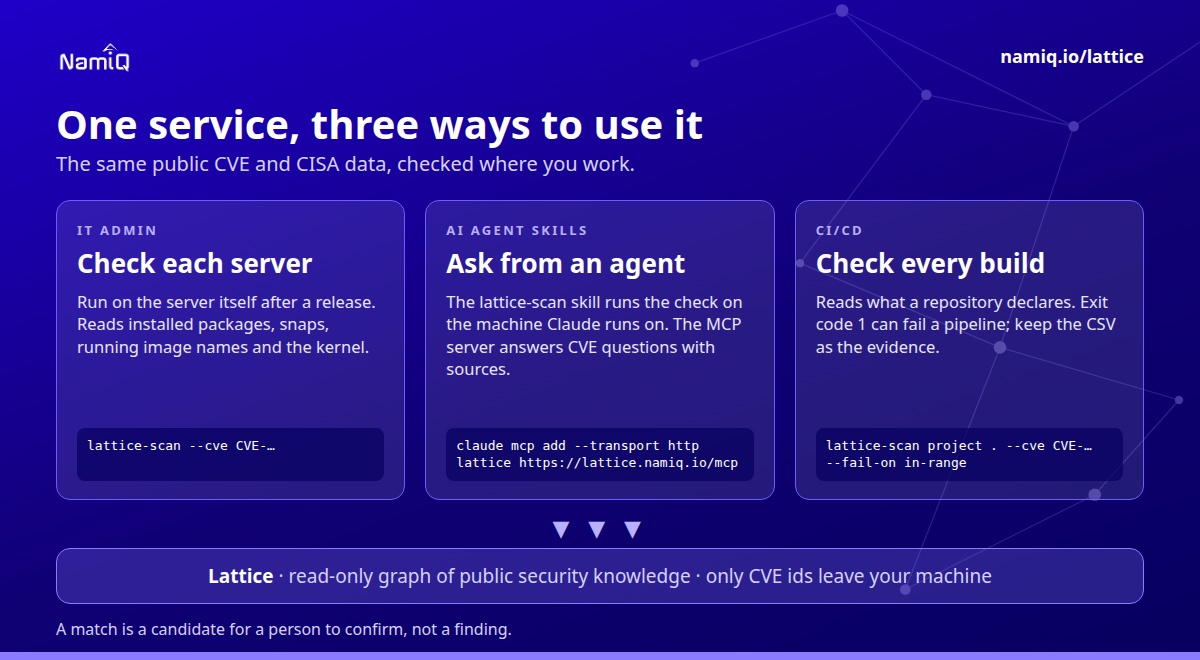
| IT admin | Run the host check on each server after a release, and again when a new entry lands. | lattice-scan --cve CVE-2026-123007 --cve CVE-2026-123633 --cve CVE-2026-121810 --cve CVE-2026-123634 --cve CVE-2026-113425 |
| AI agent skills | The lattice-scan skill runs the check on the machine Claude runs on. The Lattice MCP server answers questions about the CVEs with their sources. | claude mcp add --transport http lattice https://lattice.namiq.io/mcp |
| CI/CD | Check the repository on every pull request. Exit code 1 fails the pipeline; keep the CSV as the evidence. | lattice-scan project . --cve CVE-2026-123007,CVE-2026-123633,CVE-2026-121810,CVE-2026-123634,CVE-2026-113425 --fail-on in-range |
- Which way into Lattice fits your job →The command line, the Claude skill or the MCP server: what each needs, what works without a key and how to read the result.
- Lattice, the MCP server →The public graph the command reads, for AI agents over MCP.
- Install and connect →The signed apt repository, the fingerprint, and the connection commands for each client.
What we do not know yet
- The kernel SCTP flaw: no CVE id, no patch and no list of fixed kernels yet.
- Whether anyone is using these. CISA's assessment on 18 November was exploitation none; that can change without notice, and four credited reporters for CVE-2026-123007 suggest others can find it too.
- How many of the 56.7 million hosts have HTTP/2 enabled and reachable. The version figures cannot say.
- Exploitability on Arm and with musl. Xint's demonstrated path uses x86-64 glibc behaviour; F5 does not distinguish.
- When products that embed nginx ship fixes. Each vendor's own advisory decides it.
If you take one thing from this: the update is one package and one restart. The work is the nginx you did not know you ran, inside images, controllers and appliances, and the one that cannot be fixed at all because its project has stopped. If that list takes more than an afternoon to produce, fix that too.
Read next
- Java4Shell, CVE-2026-114938 →The other runtime-level disclosure of the week: Java services behind many of these nginx front ends.
- PHP2Shell →How a web flaw chains with a kernel flaw to root, and what that changes in the patch order.
- Today's exploited list →Where these sit among the flaws CISA added this week, in deadline order.
- The CVE Triage Handbook →How to check, analyse and triage a CVE yourself. Free with registration.
Sources
- Xint: nginx2root, remote code execution (18 Nov 2026)
- nginx security advisories
- nginx 1.31.9 release notes
- F5 K000163926 (CVE-2026-123007)
- F5 K000163928 (CVE-2026-123633)
- F5 K000163927 (CVE-2026-121810)
- F5 K000163925 (CVE-2026-123634)
- F5 K000163931 (CVE-2026-113425)
- CVE records for the five CVEs (F5; CISA SSVC entries)
- CISA Known Exploited Vulnerabilities catalog (version 2026.11.18: none listed)
- FIRST EPSS (scores read 19 Nov 2026)
- Kubernetes: Ingress NGINX retirement (11 Nov 2025)
- kubernetes/ingress-nginx (archived)