PHP2Shell: what to do this week about the two PHP flaws patched on 21 October
Update, 2 November 2026: the note now ends with Step 5, which checks every server and project with lattice-scan, and the analysis report is reissued as version 1.4 with the CISA listing and the same step. It also gains a section on how these flaws chain with Fragnesia, with the attack chain stage by stage, and a table and picture for IT admins, AI agent skills and CI/CD. The facts above are otherwise as of the dates given.
Update, 28 October 2026: CISA has also added Linux kernel flaw CVE-2026-46300 (Fragnesia) to the catalog, with a due date of 31 October, and says in the entry that it can be chained with these two PHP CVEs to implant PHP webshells and run commands as root. If you run PHP on Linux, patch the kernel as well as PHP. We cover the kernel flaw, and what the chain changes, in a separate note.
Update, 26 October 2026: CISA has added both CVEs to its Known Exploited Vulnerabilities catalog, with a due date of 29 October. The note below was written on 22 October, when neither was listed; where it says so, read it with this update. The advice does not change: patch, or take internet-facing PHP offline until you can. Source: CISA KEV catalog.
On 21 October 2026 the PHP project shipped an out-of-band security release for two critical flaws in the PHP engine itself: CVE-2026-109618 and CVE-2026-109619, together nicknamed PHP2Shell. They are not bugs in WordPress, Laravel or your own code. They are in the runtime underneath all of them, so a clean application on an unpatched PHP is still exposed.
This note is for you if you run, host or are responsible for anything written in PHP and need to decide what to do this week. Everything below is as of 22 October 2026, and every claim links to its source at the end. The story is moving fast. Check the sources before acting on anything time-sensitive.
The short version
- Fixed releases: PHP 8.5.12, 8.4.27, 8.3.36 and 8.2.35. Anything earlier on those branches is vulnerable.
- Affected range: the PHP project and Google put it at 5.4 through 8.5.11, so roughly every PHP release since 2012.
- PHP 8.1 and older get no new official release. Your fix there comes from your Linux distribution or an LTS vendor, or from upgrading to 8.2 or later.
- Severity: 9.2 (Critical, CVSS 4.0) from the PHP security team, with no login and no user interaction needed.
- Exploitation: attempts were seen before and on release day. Update, 26 October: CISA added both CVEs to its Known Exploited Vulnerabilities catalog, with a remediation due date of 29 October 2026. Ransomware use is not recorded. Working attacks against a default install had not been shown publicly when we last checked.
- Patching is the only complete fix. The workarounds reduce exposure; they do not close it.
- On Linux, patch the kernel as well. CISA says the kernel flaw CVE-2026-46300 (Fragnesia) can be chained with these two to plant a webshell and run commands as root. The chain is below.
 Free analysis report · 17 pagesPHP2Shell: Assessment & Action PlanThe full version of this note as an analysis report to hand to whoever runs your servers: severity decoded, a dated exploitation timeline, exposure by deployment, a per-host patch procedure, compensating controls with their costs, a hunting checklist and a definition of done.Download the analysis report →
What the two bugs actually are
CVE-2026-109618 ("RCE via OOM corruption"). When PHP runs out of memory, it aborts the request by jumping straight out of the code that was running. If that happens while internal request data is only partly set up, the cleanup that follows can read or act on data that was never valid. The PHP advisory says this can lead to remote code execution. Malformed multipart uploads are one way to push a request into that state: a missing content length, an unlimited number of part headers, or empty file fields.
CVE-2026-109619 ("RCE via stale global state"). PHP can keep internal state, such as error, session or extension state, pointing at memory that belonged to a request that has already finished. When the same worker process picks up the next request, some code runs before that state is reset and can read the freed memory, a classic use-after-free. The advisory names two confirmed paths. One is PHP 8.5's fatal-error backtraces. The other is session upload-progress handling. For this one to work, the attacker's two requests have to land on the same worker.
In plain terms, the first bug can corrupt memory within one request, and the second can carry corruption from one request into the next. Researchers chained them to get code execution.
Who is exposed
The PHP project's position is that every installation serving web requests is at risk: PHP-FPM, Apache with mod_php, php-cgi, FrankenPHP and LiteSpeed. Risk is highest with mod_php, where a demonstrated exploit fires from an unauthenticated request before any of your application code runs.
Researchers have confirmed pre-authentication code execution against specific versions of WordPress, Drupal, Joomla and Magento. That is not the full list. Those platforms are named because they are the ones people tested first.
Places PHP hides that teams forget to count:
- Container images you built yourself. Rebuilding on the same base image tag may not pull a patched PHP.
- Managed platforms that do not patch automatically. On Google Cloud, App Engine flexible must be redeployed, and Cloud Run is patched only if automatic base-image updates are switched on. Other clouds have similar splits.
- Hosting control panels, admin tools and vendor appliances with PHP inside. Check each vendor's advisory. Fortinet and F5 have already published theirs.
- Old internal tools on 7.x that nobody owns, which are exactly the ones with no upstream fix.
How bad is it, really?
This is where the early coverage disagreed, so here is each position and where it came from.
Severity. The PHP security team rates both bugs 9.2 under CVSS 4.0. Its vector marks attack complexity as high and says attack prerequisites are present. That is critical, but not trivial. CVE IDs that circulated before release carried a 10.0, which the PHP Foundation says was incorrect. Some vendors quote 9.8 under the older CVSS 3.1. Several early summaries, including the first internal draft of this note, called exploitation low-complexity. The official vector says otherwise.
Exploitation. Amazon Threat Intelligence saw an attempt against its honeypots on 17 October, four days before disclosure, and further attempts from what looked like multiple actors on 21 October. Cloudflare reported early attacks on the morning of 21 October, hours before the 14:00 UTC release. watchTowr reports exploitation attempts against both bugs. On the other side, CISA's alert said it had not observed exploitation when it published. Neither CVE was in CISA's Known Exploited Vulnerabilities catalog (version 2026.10.21) when we checked it on 22 October.
Working exploits. The PHP security team found no functional exploits at release. On 22 October Sansec revised its view to say mass exploitation now looks less likely: the public proof-of-concept code it examined does not work against a default PHP install, and most of it needs a separate file-inclusion bug in the target application. Some exploit code circulating has not been verified and may contain malware. Do not run it to test yourself.
Attempts are real; reliable mass exploitation has not been shown. That is a reason to patch on a plan, starting today with whatever faces the internet. It is not a reason to wait.
One recommendation deserves weight because it changes what you look for. Amazon advises starting any investigation from 17 October, not from the disclosure date. If an internet-facing PHP server stayed unpatched over that period, look at its logs from then onwards.
How these flaws chain with the Linux kernel flaw Fragnesia
On 28 October CISA added the Linux kernel flaw CVE-2026-46300, nicknamed Fragnesia, to its Known Exploited Vulnerabilities catalog (due 31 October) and said in the entry that it can be chained with these two PHP flaws to implant PHP webshells and run commands as root. The reason it fits is simple. A PHP flaw gives an attacker the web server's account on the machine. Fragnesia is a local privilege escalation, scored 7.8 under CVSS 3.1 for needing only local access and low privileges, and the web server's account is exactly that foothold. Alone, each is a smaller problem: PHP2Shell without it leaves the attacker as an unprivileged user, and Fragnesia without it needs a way onto the machine. Together they take an attacker from an internet request to root.
Internet request
   |  1. PHP2Shell: CVE-2026-109618 / CVE-2026-109619 (PHP, no login)
   v
Code runs as the web server's account
   |  2. A PHP webshell is written to a web-writable folder (CISA)
   v
Commands run as the web account, and stay available
   |  3. Fragnesia: CVE-2026-46300 (Linux kernel, local, low privilege)
   v
Commands run as root (CISA)| Stage | What happens | What breaks it | What to look for |
|---|---|---|---|
| 1. Entry: PHP2Shell | An unauthenticated multipart request makes PHP corrupt memory (CVE-2026-109618) or reuse stale state (CVE-2026-109619), and researchers chained them to code execution as the web account. | Patch PHP to 8.5.12, 8.4.27, 8.3.36 or 8.2.35 and restart every worker; until then block multipart requests or take the system offline. | Multipart requests with odd structure, bursts of out-of-memory fatal errors, worker crashes. |
| 2. Foothold: webshell | CISA says PHP webshells are implanted. A webshell is a script left in a web-writable folder that runs commands on request, so access survives after the first request. | Patching PHP does not remove a shell already planted. Make web directories read-only to the web account where the application allows it, and rebuild a host that has one. | New or changed PHP files in web roots and upload directories; PHP workers starting shells or fetching tools. |
| 3. Escalation: Fragnesia | The kernel merges network buffers and loses a marker that says the memory belongs to someone else. Decrypting ESP traffic then writes over the file cache, so a cached copy of a setuid program can change while the file on disk does not. The next run of that program gives root. The write-up says the proof of concept needs the espintcp module. | Update the kernel and reboot, or use a vendor live patch. Stop-gap: block esp4, esp6 and rxrpc, which breaks IPsec on hosts that use it. | Root activity that no administrator owns: new accounts, SSH keys, scheduled jobs, services. A disk integrity check will not see an altered cache. |
| 4. Result: root | Commands run as root. On a container host, the write-up argues that a compromised container can reach the host. | Nothing at this stage prevents it; this is why stages 1 to 3 matter. | Rotate every secret the host could read and rebuild from a known-good image rather than clean in place. |
What the chain changes. On a Linux host that runs PHP, patching PHP is no longer enough and patching the kernel is no longer a later job: the two fixes close two ends of one path, and the kernel one needs a reboot or a live patch. Rank hosts that run PHP first for both. If a host was exposed to the PHP flaws unpatched, treat it as possibly compromised to root and look for evidence the chain ran, because the second step now has a CISA listing of its own.
What we know and what we do not. The chain is CISA's statement in its catalog entry. We found no independent write-up of how the steps join, so laying them end to end is our reading of the entries and the write-up, and we have not run any of it. Whether it has been used in the wild is not stated.
Step 1 — Find out which version you are actually running
This is the step most likely to give you a false answer. Debian, Ubuntu, Red Hat and others backport security fixes into their existing packages without changing the version number. php -v can report 8.1.2 on a fully patched Ubuntu server and 8.3.20 on an unpatched one. Read the package changelog, not the version string:
# Version as reported (useful, but not proof either way on distro packages)
php -v

# Debian / Ubuntu: is the fix in the installed package?
zgrep -l CVE-2026-109618 /usr/share/doc/php*-common/changelog.Debian.gz

# RHEL / Alma / Rocky / Fedora
rpm -q --changelog php-common | grep -E 'CVE-2026-10961(8|9)'

# Containers: check the image that is running, not the Dockerfile
docker exec <container> php -v
Check what the web server uses, not what the command line uses. PHP-FPM and the CLI can be different binaries with different configuration. Confirm the version and settings from a request served through FPM, for example a phpinfo() page on localhost that you delete straight afterwards.
Step 2 — Patch, then restart every worker
- On 8.2 to 8.5: upgrade to 8.2.35, 8.3.36, 8.4.27 or 8.5.12, or install your distribution's patched package.
- On 7.4 to 8.1: use your distribution's or LTS vendor's backported package if you have one. The PHP security team has published minimal source backports for these branches but will not cut releases. Plan the move to 8.2 or later regardless.
- On 5.4 to 7.3: there is no fix from the PHP project. Upgrade, isolate, or pay for an extended-support vendor.
- Restart PHP-FPM, Apache and any long-running PHP worker. A patched binary on disk does nothing for a process that loaded the old one.
- Rebuild container images from a patched base and redeploy. Then check the running image, not the build log.
- On Linux, update the kernel and reboot (or use a vendor live patch) for CVE-2026-46300, starting with the hosts that run PHP. See the chain above.
Step 3 — If you cannot patch today
CISA's advice is blunt: if you cannot patch right away, or you run PHP 8.1 or earlier, take the PHP system offline until it is updated. That is the safe default for anything internet-facing. Sansec, looking at the exploit code available on 22 October, judges that most online stores do not need to go offline. Which one you follow is a risk decision for you to make. What matters is that someone makes it deliberately rather than by default.
If a system has to stay up, both PHP advisories are explicit that these workarounds reduce exposure but do not make an installation safe. Use them to buy days, not weeks, and restart every worker after any configuration change:
- Block multipart/form-data requests at the web server or proxy if the application does not need file uploads. Every known trigger uses multipart. The cost is that uploads break, so test any upload, cart or checkout flow, and remove the block after patching.
- Set session.upload_progress.enabled = 0. This blocks the demonstrated session path of the second bug. PHP suggests keeping it off even after patching if you do not use the feature.
- On PHP 8.5, set fatal_error_backtraces = 0.
- Keep post_max_size conservative, cap request body size at the proxy, and lower max_input_nesting_level and the limits on input variables, multipart parts and uploads.
- PHP-FPM: consider pm.max_requests = 1 so each worker handles one request and stale state cannot carry into the next. It costs throughput, so measure it.
- memory_limit = -1, enforced so applications cannot override it, removes the out-of-memory trigger for the first bug. It also removes PHP's guard against a runaway script, so one request can exhaust the server. Watch memory closely and restore the limit after patching.
- Do not use RLIMIT_AS or RLIMIT_DATA as a memory cap. The PHP advisory warns they trigger the vulnerable path.
A web application firewall helps at the edge, but only for traffic that passes through it. Cloudflare has deployed managed rules, available on its free plan too, and calls them a stopgap. Google gives equivalent Cloud Armor guidance. Neither protects an origin that can be reached directly.
Step 4 — Check whether it already happened
- Before you rebuild a server you suspect, preserve its logs and, if you can, a disk image. Patching and redeploying destroy the evidence you would need later.
- From 17 October onwards, look for multipart requests with unusual structure: huge or missing content lengths, very many parts or headers per part, empty file fields. Look also for bursts of out-of-memory fatal errors in the PHP log, and for worker crashes or segmentation faults.
- On the host, look for PHP worker processes starting shells or downloading tools (CISA calls this out specifically), outbound connections from web workers, and new files in web-writable directories.
- Assume the chain may have run on an unpatched PHP host: look for new PHP files in web roots, then for root activity that no administrator owns (new accounts, SSH keys, scheduled jobs, services). A disk integrity check will not show the kernel step.
- Your scanner and EDR vendors are shipping detections: Tenable, Google Security Operations, Wiz and others have published theirs. Make sure they are switched on, then treat a clean scan as one input, not proof.
Step 5 — Check every server and every project, and keep the evidence
Steps 1 to 4 are done by hand, one server at a time. To do the same over a fleet, and to keep a record, use the open-source lattice-scan command line. Run on the server itself, it reads the installed packages, snaps, the hardware, the running container images with their operating system and packages, and the kernel, compares them with the CVE ids you name, and sends only those ids out. Naming the CVEs needs no key.
# on each PHP server, after patching and restarting
lattice-scan --cve CVE-2026-109618 --cve CVE-2026-109619
A match is a candidate for a person to confirm, not a finding. A distribution can fix a CVE under an unchanged version number, which is the same trap as in Step 1, so on Debian-family hosts read the changelog line the report shows. By default it opens the images your containers are running and reads their operating system and package list, not the stopped images or the Python, Node, Java and Ruby packages inside them; a deep scan (--deep) reads those too. Run it from the server, not from the laptop or CI runner that deploys to it, and keep its output with the change record.
For the code you ship, the project check reads what a repository declares. It reads Dockerfiles and compose files, such as a FROM php:8.3 line or an apt-get install of PHP packages, and it does not read composer.json, so a PHP application's Composer dependencies are not covered; the base image is. A tag without a patch number cannot show whether the fix is in, so confirm the image that is actually running.
lattice-scan project . --cve CVE-2026-109618,CVE-2026-109619| For | What to do | Command |
|---|---|---|
| IT admin | Run the host check on each server after a release, and again when a new entry lands. | lattice-scan --cve CVE-2026-109618 --cve CVE-2026-109619 |
| AI agent skills | The lattice-scan skill runs the check on the machine Claude runs on. The Lattice MCP server answers questions about the CVEs with their sources. | claude mcp add --transport http lattice https://lattice.namiq.io/mcp |
| CI/CD | Check the repository on every pull request. Exit code 1 fails the pipeline; keep the CSV as the evidence. | lattice-scan project . --cve CVE-2026-109618,CVE-2026-109619 --fail-on in-range |
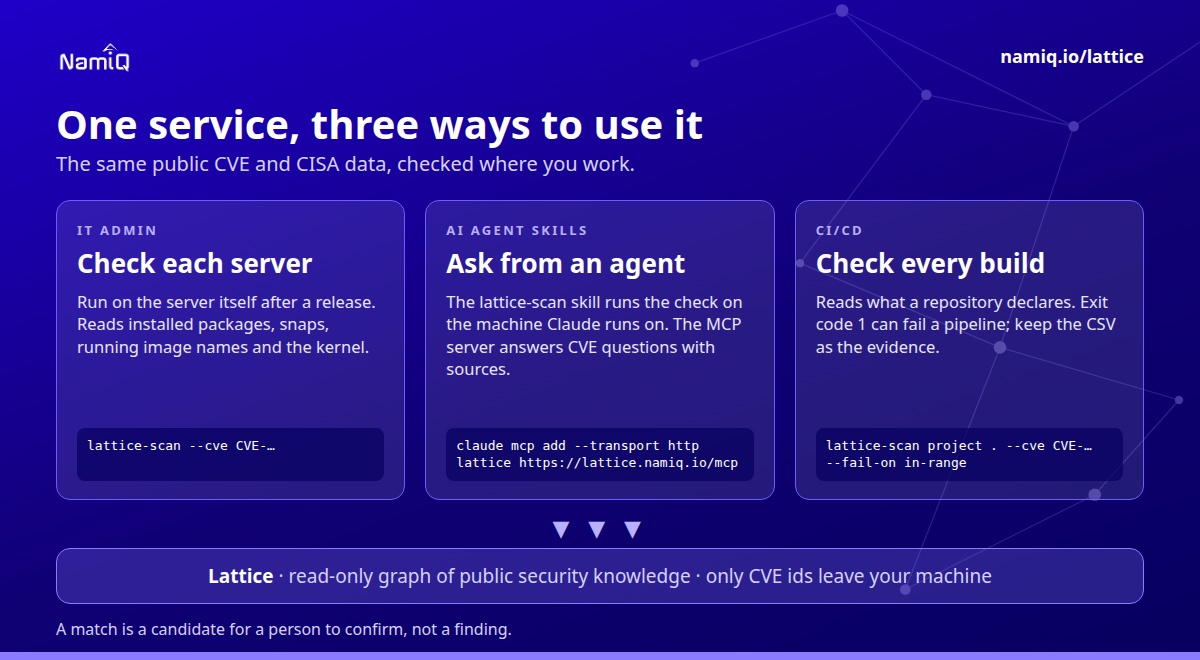
Guide: namiq.io/lattice/guides/choose-your-channel. MCP server (io.namiq/lattice in the MCP registry): namiq.io/lattice. Package: pypi.org/project/lattice-scan, or namiq.io/apt.
- Which way into Lattice fits your job →The command line, the Claude skill or the MCP server: what each needs, what works without a key and how to read the result.
- Lattice, the MCP server →The public graph the command reads, for AI agents over MCP.
- Install and connect →The signed apt repository, the fingerprint, and the connection commands for each client.
What we do not know yet
- Whether ransomware groups use these flaws. CISA added both CVEs to its Known Exploited Vulnerabilities catalog on 26 October (due 29 October) and records ransomware use as not recorded, which is not the same as no ransomware use.
- Whether a reliable exploit against a default configuration appears. Sansec's revised view could change in either direction.
- Whether the PHP and kernel chain has been used in the wild, and how its steps join in detail. CISA states the chain; we found no independent account.
- Which appliances and hosted products embed a vulnerable PHP. Vendor advisories are still arriving.
If you take one thing from this: the hard part is not the patch. It is knowing every place PHP runs, and which of those places has an owner. If that list takes you more than an afternoon to produce, fix that too, because the next runtime-level bug will ask the same question.
Sources
- PHP security advisory GHSA-w8hw-w9fx-j79w — CVE-2026-109618, RCE via OOM corruption
- PHP security advisory GHSA-6wmf-4rv5-p3rp — CVE-2026-109619, RCE via stale global state
- CISA alert — Critical Vulnerabilities in PHP Require Immediate Patching (21 October 2026)
- CISA Known Exploited Vulnerabilities catalog
- Google Cloud — Responding to core PHP vulnerabilities CVE-2026-109618 and CVE-2026-109619
- Tenable — php2shell frequently asked questions (exploitation timeline, versions, detection)
- Sansec — PHP2Shell research and 22 October update
- Fortinet PSIRT FG-IR-26-186
- F5 — K000163821, PHP vulnerabilities CVE-2026-109618 and CVE-2026-109619